
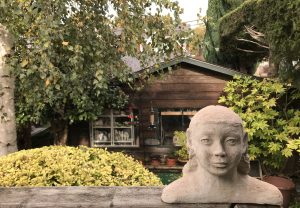
 Here is a 1958 plaster bust – of me – made by my dear mother, created in the UBC Ceramics huts, in a clay sculpture class with Santo Mignosa. I have found few philosophical definitions of clay sculpture that recognize it as a stand-alone art-form, free of the vessel metaphor, or the lure of historic ceramics, or judged by its material processes.
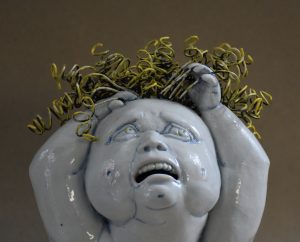 Clay is a humanist material that can innately and physically transcribe actions, ideas, and emotions into art objects. Many of us have lost confidence in the divine, and our outlook has migrated into modern skepticism. I think clay art is beautifully positioned to illustrate apprehensions around unknown outcomes.
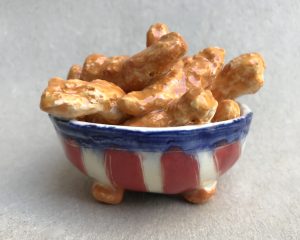 The ceramic practice gives us an abundance of material and historic resources. (So many masters degrees!) I try to balance the weight of skill, the ‘tyranny’ of process and of historical reference, with keeping to my intention. I will draw upon historic references, but for the main part it is about speaking of ‘the ‘here and now’.
 VENUS
VENUS
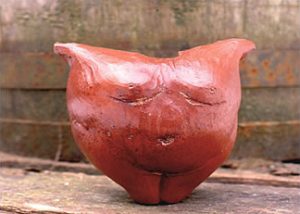
From the late 1970s to early 2000s I drew upon the image of the prehistoric stone-carved ‘Venus’ of Willendorf. She is a vessel and a formidable representation of female power. In the 1990s I was sharply criticized, by several male professors for objectifying women. Does this figure objectify women, or do some find her unconditional monumentality threatening?
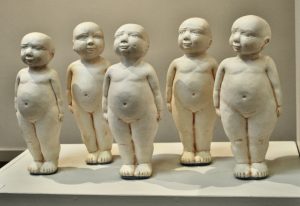 BABIES
By 2010 I had moved from the Venus vessel to the baby effigy – a closed stand-alone object/sculpture. I do like the unnaturalness of the stand-at-attention-baby. I sometimes refer to this figure as proto-human, and blur differences between male & female and adult & child.
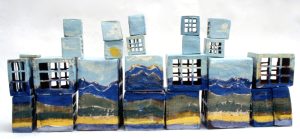 LANDSCAPE AND ARCHITECTURE
I have a love-hate relationship with my environs. I can be overpowered by our vast (Canadian) landscape and scary wildlife. I experience similar disengagement with my contemporary, faceless city. Many of my landscape and architectural pieces are about finding the ‘Genius Loci’.
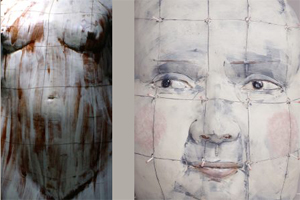 GRIDS AND ARCHITECTURE
I see the architectural grid as a symbol of the modern impersonal world of the high-rise. It is also found as an underlying structure in textiles, brickwork and cobbled streets. Grids offer order and reason.They provide lines around which to cut and open spaces. Conversely, grids can imply containment, restraint, and barriers. For all of those reasons, I draw grid lines around the curves of figures to bring them into the present day and remove a look-back at ‘the classic figure’.
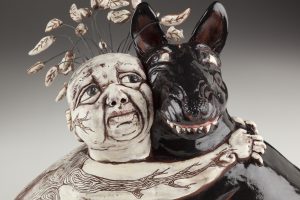 ANIMALS
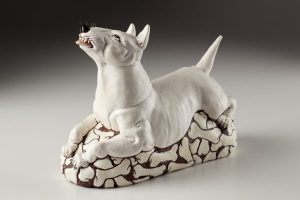
I find reassurance in the symbiotic connection between animals and humans – a bridge, for us, to the natural world. Perhaps an inter-species empathy can be one antidote to existential human-aloneness. My dogs are not dog-dogs, nor my horses, horse-horses. Their sentience can be seen in the interactions between the figures, and it can be seen in their gaze.
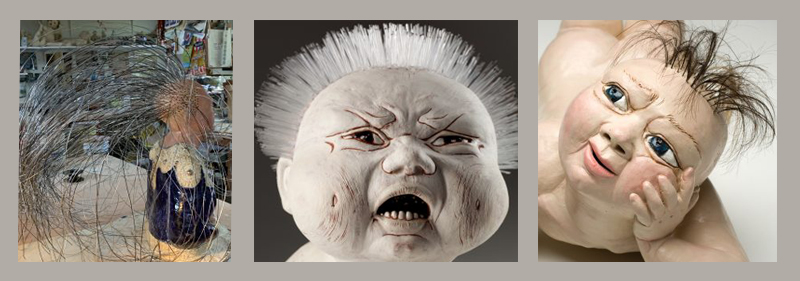
HAIR
The ‘Hair.’ It is a challenge to find a material that will increase the impact of a work, as well as imply something ‘other’, without creating distraction through the material’s own physical personality. The added material in itself is secondary, but its impact should be significant to the whole.
I return to my themes recurrently rather than in a linear fashion Many of my pieces combine attributes of all the genres listed above, and most were made to be singular and stand-alone objects, dare I say sculptures, though sculptures that do not seem to fit into any particular place. Each time I re-visit one of the genres, I am a different person. While compiling the website pages, I found that the work did not need to be in chronological order, and that some early work can still sit next to new work. I find the longevity of some of my fixations curious.
EARLY HISTORY
In 1958, our Grade 3 class was shown the NFB film, “The Story of Peter and the Potter” (1953), which showcased potters Erica and Kjeld Deichmann, who pioneered studio pottery in New Brunswick in the 1930s. The film showed them throwing, glazing and firing a pot. As the film progressed I could see that this family of potters lived and worked seamlessly, and it made sense.
In Grade 10, I started pottery classes and read “A Potter’s Book” by Bernard Leach. His philosophy fit beautifully into the ‘back to the land’ movements thriving during the 1960s/70s, and reinforced the notion of an integrated personal and working life, as demonstrated by the Deichmanns. I travelled for 1 1/2 years, and when I returned, I engaged in a six-year, self-directed apprenticeship managing a pottery school (1973 -79). I intentionally isolated myself from outside influences.
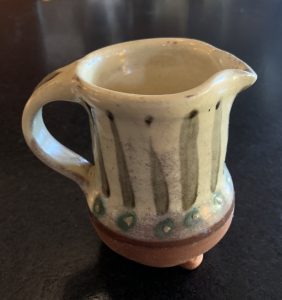 By 1979 I enrolled in the Vancouver School of Art. After graduation in 1982, from what had become the Emily Carr College of Art and Design, my husband and I built a garage/studio, where I still work. The first post-ECCAD years were spent making functional slipware using a local clay retrieved from a roadside near Haney, BC, I was thinking that I could make good sales. Slipware is a demanding and skilled practice, and making your own clay is hard labour. My decorated pottery was not a hot seller. I persisted until June 1985, when my daughter was born.
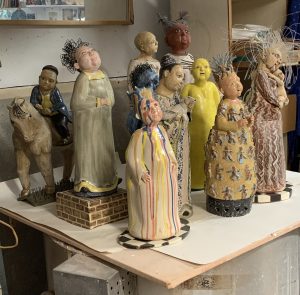 By 1979 I enrolled in the Vancouver School of Art. After graduation in 1982, from what had become the Emily Carr College of Art and Design, my husband and I built a garage/studio, where I still work. The first post-ECCAD years were spent making functional slipware using a local clay retrieved from a roadside near Haney, BC, I was thinking that I could make good sales. Slipware is a demanding and skilled practice, and making your own clay is hard labour. My decorated pottery was not a hot seller. I persisted until June 1985, when my daughter was born.
EARLY INFLUENCES
I love all forms of ceramics – traditional, ancient, Leach/ Mingei, modernist, functional, installations, the deeply personal, the figurative, the purely sculptural, and Funk – with its irony and irreverence. Other powerful influences have come from the work of maverick BC artists: Gathi Falk’s magic ceramics, Emily Carr’s mythic trees, and E.J. Hughes’s obsessive regional paintings, and Liz Magor’s elegant constructs. I must include the ‘gothic’ English Martin Brother’s birds, and the charm and slap-dash of Staffordshire figures. In 1973, in Toronto, en route home after my travels, I was entranced by a wicked Joe Fafard clay figure, the exuberance of which guided my work during my early pottery-school apprenticeship in the 1970s.
 By 2005 I woke-up to realizing that BC ceramic artists were remaining anonymous, and local institutions were ignoring the ceramic practice. To create provenance around BC ceramics, I started collecting artist profiles and marks in 2011. I was assisted by John David Lawrence, a collector in Vancouver, and Allan Collier, also a collector and a Canadian craft and design expert. In 2018 I contacted Raine McKay, Director of the Council of BC (CCBC), seeking assistance with creating a digital platform, suggesting that all crafts should have registries to identify artists. Thanks to the CCBC, in 2022, the BC Ceramic Mark Registry – the BCCMR, was launched – it is organic and growing (in slow motion). The marks are a starting point to identity makers, and the biographies frame a 100-year history of studio ceramics in BC.
Throughout my practice I have been seeking connectivity and community, and how to locate my own practice and that of the studio ceramics in BC. Below are some people who opened doors to opportunity, along with some frighteningly random encounters, that through good fortune changed my practice.
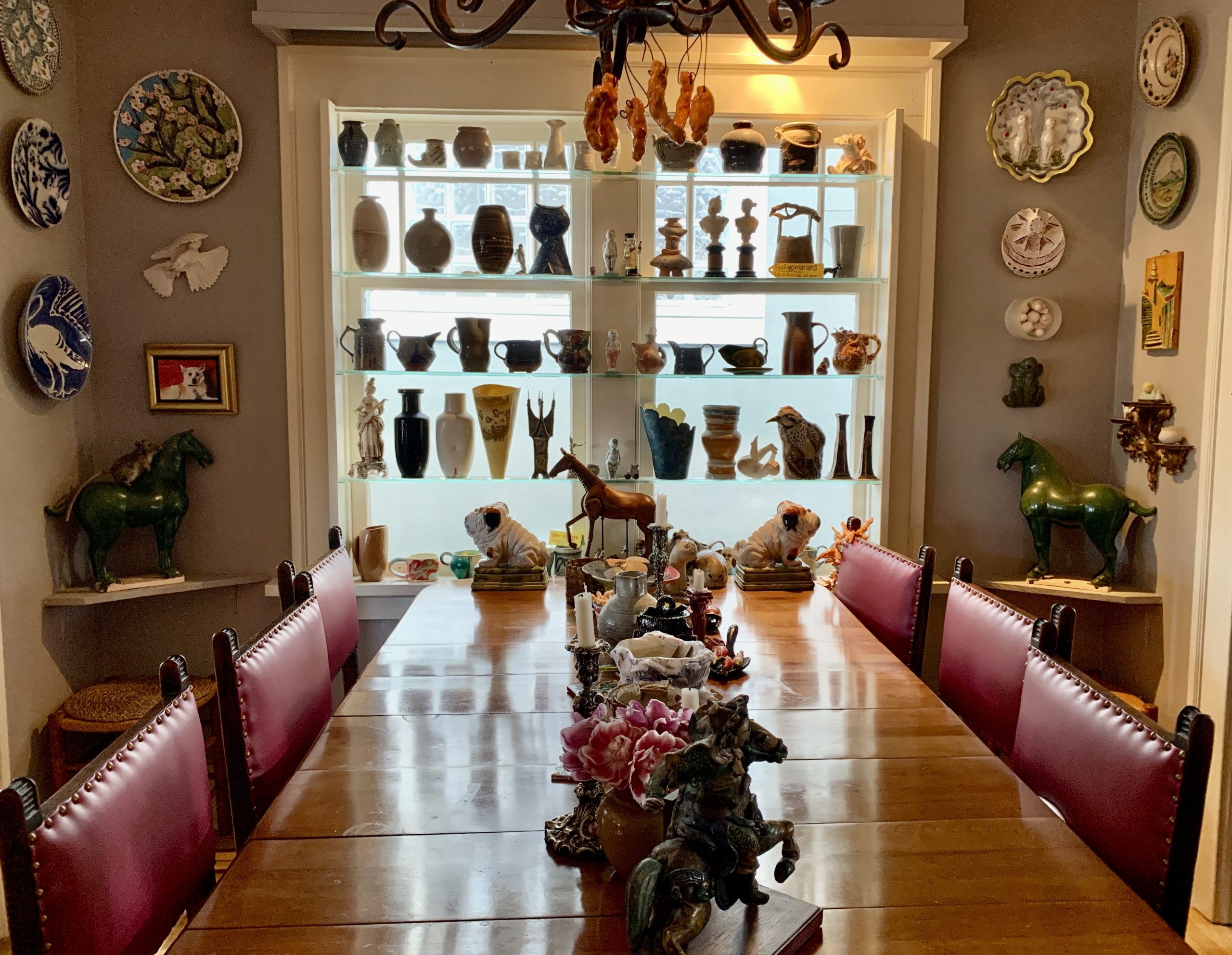 I could not, cannot, resist collecting – this is only one room of 6 others filled with clay things. I attended most of the openings at Hiro Urakami’s famed ‘House of Ceramics’ [1972-78]. Hiro was the first person to actually like my work (the wacky beavers and little brown bodies), and he gave me several exhibition opportunities in the 1970s. Hiro is a trusted adjudicator, and has a gifted ‘eye’. He opened my eyes about ways to see ceramics. For decades he has been called upon to adjudicate BC ceramic exhibitions.
In a chance encounter, in 2007, I met the Australian artist, Janet Mansfield, publisher of ‘Ceramic Art and Perception/Technical’ magazine. I stepped in when the host could not, to drive Janet around Vancouver, visiting studios and meeting artists. Janet asked me to write an article on my big dogs for her magazine, which started me writing about ceramics, an activity that has been fundamental in generating ideas around the ceramic practice.
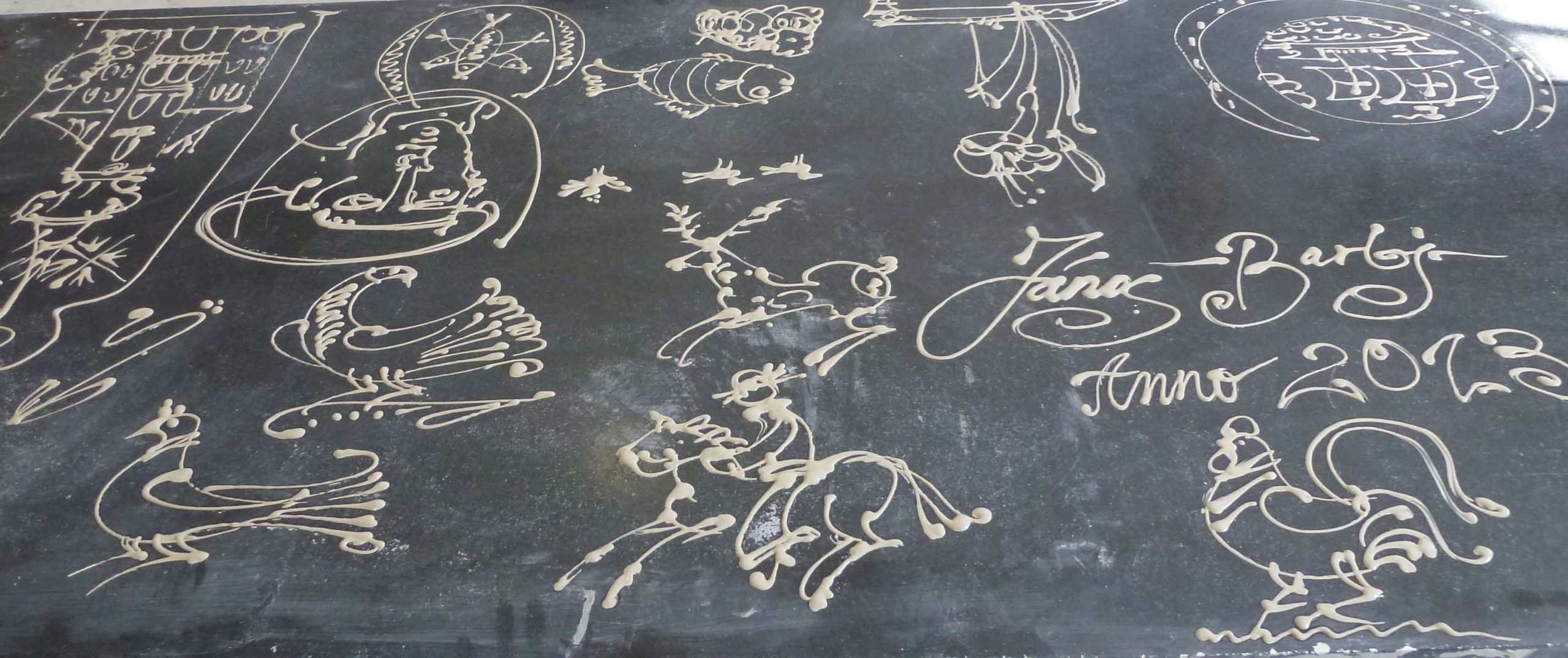 The image above, taken in 2013, shows the last demonstration of traditional Hungarian slip-trailing by János Probstner, as Director of the ICS, and Professor at the University of Budapest. In Hungary, retirement is mandatory at age 70.
In 2008, Janet Mansfield, and János Probstner, Founder in 1976, and former Director of the International Ceramics Studio (ICS) in Hungary, the oldest ceramic residency in Europe, selected one of my big dogs for the ICS, Hungarian Triennial in 2008. It was my first inclusion in an international exhibition. Fellow ceramicist and dear friend, Mary Daniel loaded me onto a plane to see the exhibition in Kecskemet, where we discovered the International Ceramics Studio and its residency – by chance – we just wandered in. This led to our decade together exploring wonderful residency experiences, in Hungary, Italy, England, and Japan – stopped by Covid.
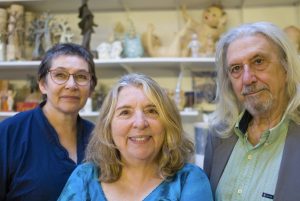 In 2009, Phyllis Schwartz of Sassamatt Publishing, approached me about preserving some glaze recipe cards written by artist Glenn Lewis while he taught at UBC during the 1970s. These recipes were derived from his Leach apprenticeship (1961-63). (By 2009 Glenn had become a famed multi-disciplinary artist.) Our collaboration became a trifecta, and we published editions of Seeking the Nuance in 2009 and 2017, and are currently working on a 2026 edition. Here, Glenn, Phyllis and I are launching the first edition of ‘Seeking the Nuance’.
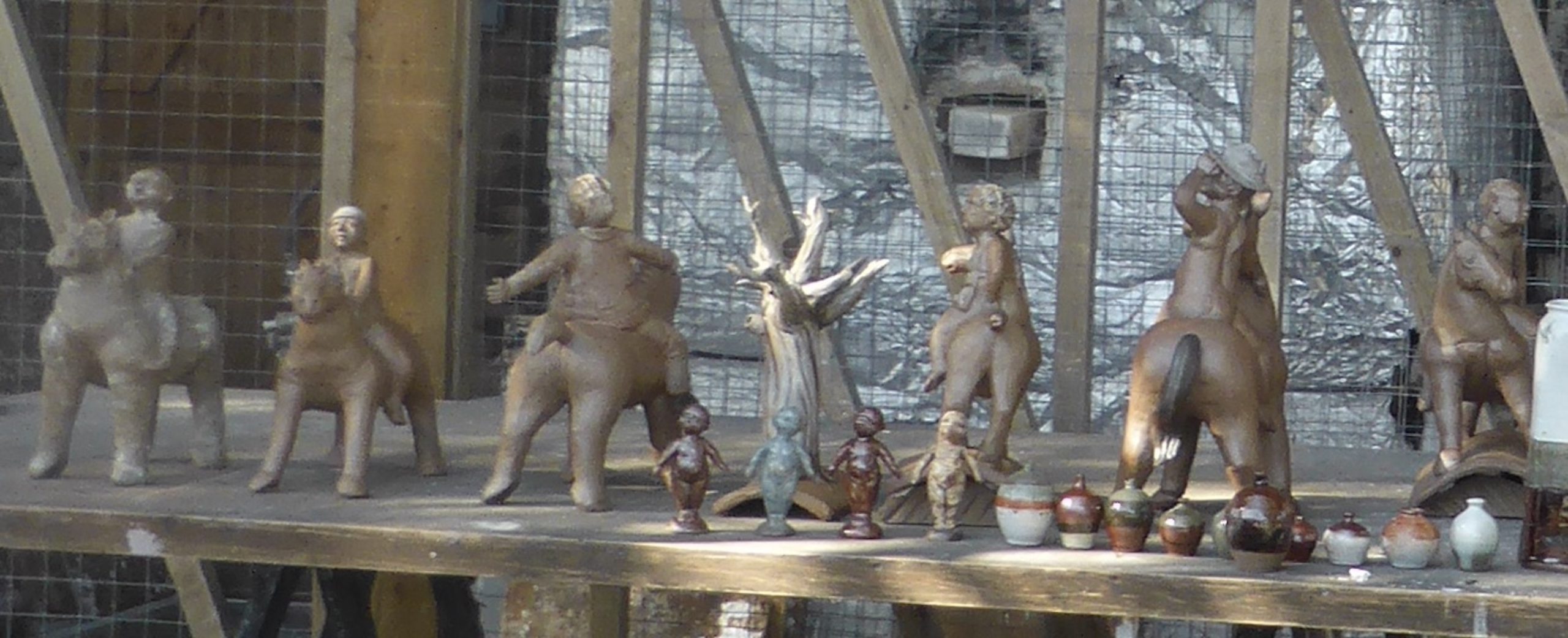 In 2012, out of the blue, I was contacted by PhD candidate, Alex Lambley of Falmouth University, UK. She had read ‘Seeking the Nuance’ and was looking into the diaspora of the Leach influence. She was coming to Vancouver for research, seeking advice about where to stay, and ended up staying with us for month. This encounter led to my being invited, in 2014, by Julia Twomlow, former Director of the Leach Pottery and Museum (2008-2016) to St Ives, UK. Julia imaginatively asked me to research and respond to two rare equestrian finials made by Bernard Leach in 1926. Thus began an extraordinary month of creating equestrian roof finials at the Leach Pottery. Several have ended up on roofs and on kilns at the Leach, and in St Ives.
It was a dream-residency, facilitated by Alex Lambley, and that that lead to other friendships; with the late artist, Peter Smith of Bojewyan Pottery, Dr. Matt Tyas – the Leach Gallery curator, and the present Director – Libby Buckley. I have returned twice to the Leach, to teach and make more finials, and hope there will be another visit. Peter Smith and I published 2 editions of ‘Up on the Roof’, through Sassamatt Publishing. In 2021, at the Falmouth University, Alex successfully defended her dissertation, “Translation and Appropriation: Mingei theory. Bernard Leach and his Vancouver Apprentices. (1958-1979)”, achieving her PhD. She has added immeasurably to the story of BC ceramics. Alex will be joining Phyllis, Glenn and I in our 2026 Nuance edition.
Dr. Carol E. Mayer is the former Head Curator at MOA, a founder of the North-west Ceramics Foundation (NWCF) in 1993, a tireless supporter of ceramic culture in BC, and the Canadian Craft Federation’s Robert Jekyll Award recipient. Carol facilitated my year-long residency at the UBC Museum of Anthropology, 2018/19, which lead to my work being installed in the Koerner Gallery for two years. My work was included in Carol’s seminal 2019/20 exhibition, ‘Playing With Fire, Ceramics of the Extraordinary,’ featuring 11 BC clay sculptors.’ Carol remains on the NWCF Board, and I am now the Chair.
I begin to appreciate, late in the day, that any art practice is a multi-sided equation. Engaged collectors, art lovers, and the curious public, operate in partnership with artists. Collectors are the stewards of an object’s provenance, they become custodians of the object’s story, and they metamorphose, inevitably, into creatures of object-love. It is the collectors who are the first guardians of those objects, which by virtue of being collected, become aesthetic purveyors of the time and place of their origins. At the end of the day there must be somebody to make art for.
Throughout, my husband, Terry Yip – a copper-bottomed dad – has provided elemental and steadfast support. He is a sensitive photographer, able to capture the moment, and he has been a gifted problem-solver in all our endeavours.